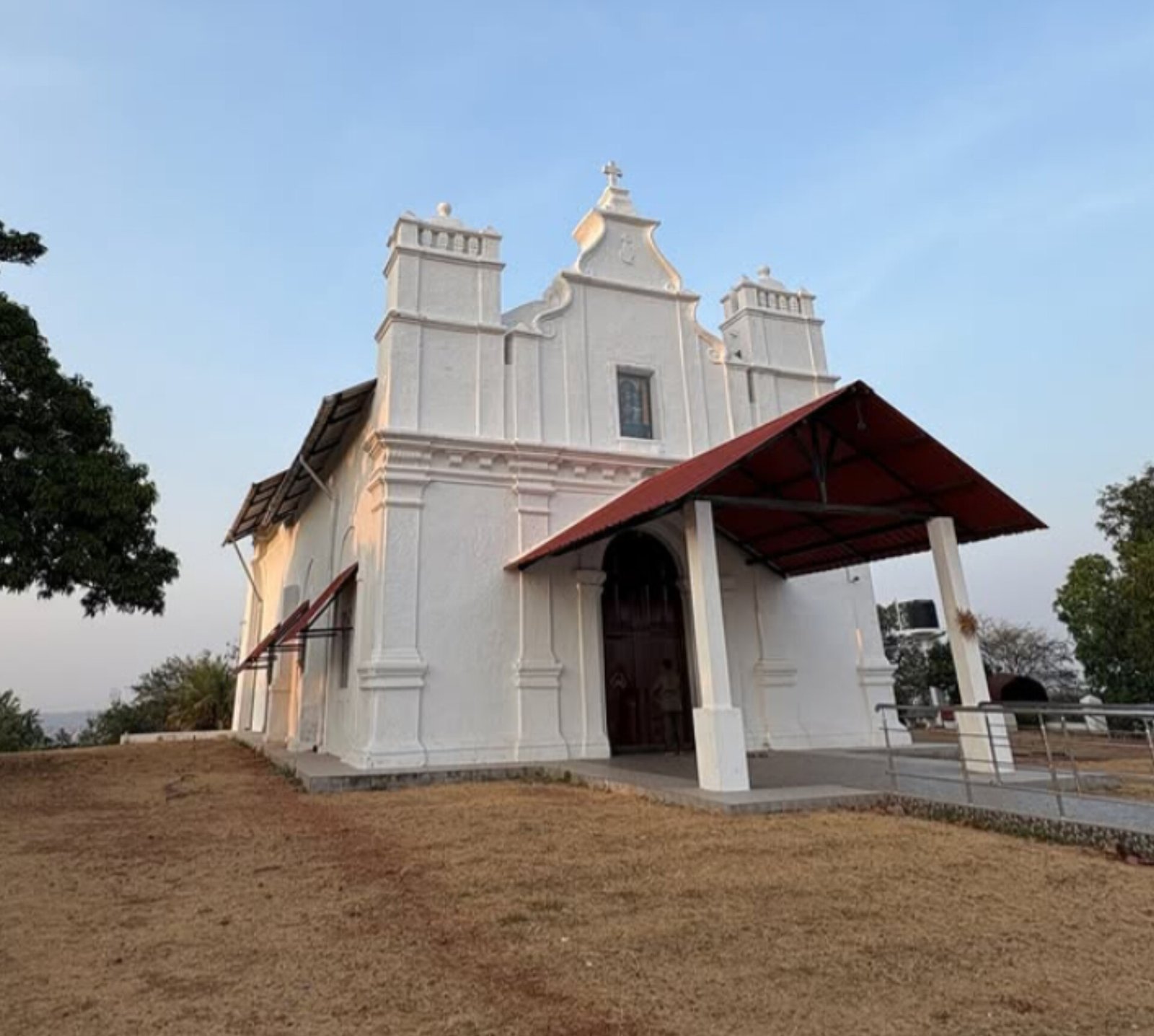
Three Kings Church in Goa is one of those rare places where the lines between history, faith, folklore, and natural beauty blur so seamlessly that you cannot separate one from the other. Perched on a quiet hill in the village of Cansaulim, in South Goa’s Salcete taluka, this whitewashed church has stood for centuries, gazing out over paddy fields, palm groves, and the shimmering Arabian Sea far beyond. Its elevated location makes it visible from miles away, and the journey to reach it feels almost symbolic — a slow climb away from the noise of everyday life to a place where the air is cooler, the sky feels closer, and the mind naturally quiets down. Visitors often say that the moment they step onto the church grounds, they feel a shift in atmosphere, as if time has slowed. This isn’t just because of the peaceful surroundings, but also because of the heavy weight of stories and legends that cling to this hilltop like the salty Goan breeze.
The church’s official name is Our Lady of Remedios Chapel, dedicated to the Virgin Mary. Built during the Portuguese colonial era, likely in the 16th or early 17th century, it served as a small place of worship for the surrounding villages. Portuguese missionaries often chose hilltops for their chapels and churches, not only because of the symbolism of being closer to God but also because such locations made them visible landmarks in the landscape. The sight of a white structure against the green of the fields or the blue of the sky was a constant reminder of the presence of the Church and its teachings. In those days, these chapels were not just religious centers but also social hubs where people gathered for festivals, meetings, and community decisions.
Despite its small size, Three Kings Church gained fame far beyond Cansaulim, not because of its architecture alone but because of a legend that is as chilling as it is fascinating. This is the story of the three kings from whom the church takes its popular name. According to local folklore, there were once three minor rulers in this part of Goa, each controlling a small kingdom. Their territories were close, and their ambitions were great. While they shared a fragile peace, each king desired to rule over all the land. One of them, more cunning than the others, devised a deadly plan. He invited the other two kings to a feast at the hilltop chapel, pretending it was a gesture of friendship. The kings arrived, unaware of the treachery ahead. During the meal, the host poisoned them both. But his triumph was short-lived. Word of his crime spread quickly among the people, who surrounded the hill in anger. Facing certain death at their hands, the king took his own life inside the chapel. The three bodies were buried nearby, and from then on, this became known as the hill of the Three Kings.
It is this tale that has fueled stories of haunting and supernatural activity for generations. Many locals claim that the spirits of the three kings still wander the hill, especially after sunset. Some speak of hearing footsteps on the church floor when no one is inside. Others tell of seeing shadowy figures or hearing whispers carried on the wind. The eeriness of the place after dark has led to strict rules — visitors are not allowed near the church at night. While rationalists dismiss these accounts as imagination heightened by the isolation of the spot, the stories refuse to fade. Even those who laugh at ghost tales tend to admit that the church has a certain energy, especially when the sun dips low and the surrounding fields grow dim.
Haunted or not, the church remains a beautiful example of the modest Portuguese-style chapels scattered across Goa. Its design is simple yet elegant, with smooth whitewashed walls that glow in the afternoon sun. A small bell tower rises above the entrance, and inside, the altar is dedicated to Our Lady of Remedios. The interior is uncluttered, with plain wooden pews and windows that allow the sunlight to spill in, casting a warm glow on the floor. It is the kind of space where the simplicity itself inspires reverence. Standing inside, you can hear the faint sound of the wind outside and perhaps the call of a distant bird — sounds that seem to belong to a slower, older world.
The church is at its most vibrant during the annual feast of Our Lady of Remedios on January 6, which also marks the Christian festival of Epiphany. This day commemorates the visit of the Magi — the Three Wise Men — to the infant Jesus, and in Cansaulim, the biblical story merges beautifully with local tradition. Every year, three boys from the surrounding villages are chosen to represent the three kings. Dressed in colorful robes and crowns, they lead a procession up the hill to the church, accompanied by music, prayers, and a joyful gathering of villagers. The event is both religious and cultural, drawing people from nearby areas. For one day, the quiet hilltop is alive with chatter, laughter, and the aroma of Goan sweets like bebinca and dodol, sold from temporary stalls. Despite the festivity, there is a deep sense of devotion, with families attending Mass and offering prayers at the altar.
Reaching the Three Kings Church is a journey in itself. The road to Cansaulim winds through the kind of Goan countryside that seems untouched by time — narrow lanes lined with coconut palms, the occasional old Portuguese villa with red-tiled roofs, and expanses of green paddy fields that sway gently in the breeze. As you approach the base of the hill, the church comes into view, its white façade standing out against the greenery. The climb is not difficult, but it is steep enough to give you the feeling of ascending to a special place. From the top, the view is spectacular. On a clear day, you can see the coastline stretching away in both directions, the beaches of Arossim and Cansaulim glinting in the sunlight. Inland, the fields and villages roll away towards the horizon, dotted with patches of forest.
For those who love photography, the Three Kings Church offers countless opportunities. The stark white building against a deep blue sky, the sweeping panoramas from the hilltop, and the soft golden light of evening make it a dream location for capturing the quieter side of Goa. Many couples have chosen it as a backdrop for pre-wedding shoots, and travel bloggers often feature it in their lists of hidden gems. However, it is important to remember that this is still a place of worship, and any photography should be done respectfully, without disturbing the locals or the sanctity of the space.
Around the church, there are a few benches where visitors can sit and take in the view. The breeze at the top is constant and refreshing, carrying with it the scent of salt from the distant sea. The sense of openness is remarkable — unlike in the crowded beach areas, here you can breathe deeply, listen to the rustling of leaves, and feel the sun on your face without distraction. This is one reason why even those who come seeking ghost stories often leave with a sense of peace.
The surrounding village of Cansaulim adds its own charm to the visit. It is known for its traditional Goan houses, small bakeries selling fresh bread in the mornings, and the friendly nature of its residents. The village market is small but colorful, with stalls selling vegetables, fish, and local snacks. A short drive from the church will take you to some of South Goa’s quietest beaches. Arossim Beach, in particular, is known for its wide stretch of soft sand and gentle waves, making it perfect for a calm evening walk after visiting the church. Unlike the more commercialized beaches up north, these southern beaches are often nearly empty, especially outside the peak tourist season.
When it comes to the supernatural reputation of the church, opinions among locals are divided. Some older residents insist that they have felt or seen things they cannot explain, especially in their youth when they dared each other to visit the hill after dark. Others shrug off the stories as exaggerated or invented to keep curious people away at night. Regardless of belief, there is mutual agreement that the church deserves respect and should not be treated as a place for pranks or thrill-seeking after hours.
In recent years, Three Kings Church has found its way into travel shows, documentaries, and online articles, which has brought more visitors but also more responsibility. The church grounds are clean, with minimal litter, thanks to the efforts of the local parish and community. There are no large commercial establishments on the hill, and this lack of commercialization is part of its charm. Those who visit should bring their own drinking water, wear comfortable shoes for the climb, and plan to come during daylight hours to fully appreciate the view.
The Portuguese influence is still very much visible in the church’s structure and in the way festivals are celebrated. The Portuguese era left a deep imprint on Goan architecture, cuisine, and religious traditions, and the Three Kings Church is a living reminder of that chapter in history. The white walls, the modest size, the emphasis on function over elaborate decoration — all these are hallmarks of the simple chapels that dotted Portuguese Goa. In this way, visiting the church is like stepping back in time to an era when such buildings were central to village life.
For travelers seeking an alternative side of Goa, away from the noise of beach shacks and party scenes, the Three Kings Church offers exactly that. It is a place where you can slow down, reflect, and absorb the layers of history and culture that make Goa unique. Whether you come for the legend, the architecture, the view, or the peace, you will likely leave with a deeper appreciation for the quieter treasures that lie off the beaten path.
Standing on the hill as the day draws to a close, the church bathed in the warm light of the setting sun, it is easy to see why this place has captivated the hearts and imaginations of so many. The air seems to hold whispers of the past — of kings and queens, of priests and villagers, of celebrations and tragedies. Perhaps that is why the Three Kings Church remains more than just a monument. It is a living story, one that continues to be told, reimagined, and cherished with every new visitor who climbs the hill.
While the written history of Three Kings Church is tied closely to Portuguese colonial records and Catholic missionary activity, much of its character comes from oral histories passed down in Cansaulim’s households. In the evenings, when the day’s work is done and families gather in the courtyard or on verandas, elders tell stories that they themselves heard from their grandparents. These retellings often blur the line between fact and folklore, but that is exactly what makes them compelling. Some versions of the Three Kings legend focus more on the political rivalry, painting the kings as ambitious but ultimately tragic figures who destroyed themselves through pride. Others add more dramatic flourishes — details about the poisoned wine, the reactions of the villagers, or the eerie stillness that fell over the hill after their deaths. In a culture where oral storytelling is an art, the church becomes more than just a building; it becomes the centerpiece of a living narrative that changes slightly with each telling.
Older residents also recall times when the hill was even more isolated than it is today. Before the roads were improved, reaching the church meant walking through rough paths lined with wild grass and shrubs. Children would run up the hill for fun, daring each other to enter the church alone. Those who were particularly brave claimed they heard noises inside — a chair scraping, a faint sigh, or the sound of cloth rustling. Whether these were tricks of the wind or products of youthful imagination hardly matters now. They are part of the collective memory of the village, adding layers to the church’s reputation.
The architecture of Three Kings Church may be simple, but a closer look reveals details that speak of the era in which it was built. The thick walls are designed to keep the interior cool, even in the peak of summer. The arched doorway and windows are typical of Portuguese ecclesiastical design, combining functionality with an understated elegance. The bell tower, though small, has a clear view of the surrounding lands, and in earlier times, the ringing of the bell could be heard across the villages below, calling the faithful to prayer. The roof, originally tiled, has undergone repairs over the centuries to prevent water seepage during the monsoon. Inside, the wooden pews are plain but sturdy, and the altar is adorned with a modest statue of Our Lady of Remedios, often decorated with fresh flowers by local parishioners.
Preservation of the church has been a community effort. While the diocese oversees its upkeep, much of the cleaning and minor repairs are done by volunteers from the village, especially before the January feast. There is a sense of pride in keeping the chapel pristine, not just for religious reasons but also because it represents the village to outsiders. On feast days, women sweep and wash the steps, children help decorate with flowers, and men set up tents and chairs for visitors. This sense of ownership ensures that the church remains in good condition despite its age.
When it comes to visiting Three Kings Church, the experience can vary greatly depending on the season. The post-monsoon months from October to February are perhaps the most rewarding, as the countryside is lush, the skies are clear, and the temperature is pleasant. This is also when the views from the hill are at their best, with the sea appearing a deeper blue against the green fields. The monsoon months, from June to September, give the hill an entirely different atmosphere. The road becomes slick, mist often clings to the top, and the clouds hang low over the fields. Visiting during this time can feel more mysterious, even eerie, especially if you arrive when the mist obscures the church until you are nearly at the door. However, these months require caution, as the climb can be slippery and the winds strong.
The summer months of March to May are hot, and the climb can be tiring under the midday sun, but the evenings can still be pleasant. This is also the time when the church is less crowded, as fewer tourists venture out in the heat. Those who come during this off-season often find themselves alone on the hill, with the quiet broken only by the wind and the occasional rustle of leaves. For some, this solitude is part of the charm.
Travelers planning to visit should remember that there are no shops or cafes at the top. It’s best to carry water and perhaps a small snack, especially if you intend to linger. Modest dress is appreciated, as the church is still active for services. Photography is allowed, but it’s courteous to avoid blocking the entrance or disturbing anyone in prayer.
Local perspectives on the church’s haunted reputation are interestingly varied. Some villagers embrace it as part of the site’s mystique, noting that it has drawn curious visitors who might not have come otherwise. Others worry that it overshadows the church’s religious importance, turning it into a ghost-hunting spot rather than a place of faith. The parish has made it clear that the church should not be treated as a thrill destination. Stories aside, they say, this is first and foremost a sacred site.
The annual feast is when the church truly comes alive. Preparation starts days in advance, with rehearsals for the procession and careful selection of the three boys who will play the kings. This is considered an honor, and the families of the chosen boys often keep photographs as cherished mementos. On the morning of the feast, villagers dress in their best clothes, the air is filled with the sound of hymns, and the aroma of traditional Goan dishes drifts up the hill. After the religious ceremonies, people linger to chat, exchange news, and enjoy the food. It’s a celebration that strengthens the community bonds as much as it honors religious tradition.
Cansaulim itself is worth exploring after a visit to the church. The village has a few bakeries known for their soft poee bread, best enjoyed with a smear of butter or a slice of local cheese. The slower pace of life here is a contrast to Goa’s busier coastal towns, and a stroll through its lanes reveals houses painted in cheerful colors, their balconies overflowing with potted plants. The people are warm and welcoming, and it’s not uncommon for strangers to be invited in for a cup of tea.
The beaches nearby — Arossim, Cansaulim, and Velsao — are all relatively quiet compared to Goa’s famous stretches. The sand is soft and clean, and the waters are calmer here, making them ideal for swimming or simply relaxing by the shore. Watching the sunset from these beaches after a trip to the Three Kings Church is a fitting way to end the day. The sky often turns shades of orange, pink, and purple, reflecting off the water in a display that feels almost cinematic.
In recent years, the church has also become a point of interest for students of history and architecture. Its survival over centuries, despite exposure to the coastal climate, is a testament to the quality of Portuguese construction methods and the dedication of those who maintain it. For historians, it is a physical link to a time when Goa was a key part of the Portuguese empire, influencing trade, religion, and culture across the Indian Ocean.
For some travelers, the attraction of the Three Kings Church lies entirely in the view from the top. For others, it is the legend of the kings. Still others come seeking a moment of prayer or reflection. This variety of motivations is part of what makes the site unique — it has something to offer to everyone, whether their interest is spiritual, historical, cultural, or simply scenic. The important thing is that all these experiences coexist without one overshadowing the other, creating a layered, multifaceted identity for the church.
Standing there in the late afternoon, as the sun casts long shadows and the fields below take on a golden hue, you begin to understand why this place continues to capture the imagination. The wind feels stronger at the top, carrying with it the scent of the sea and perhaps, if you believe the stories, the whispers of the three kings themselves. Whether you come away with a photograph, a prayer, or a story to tell, the visit will stay with you.