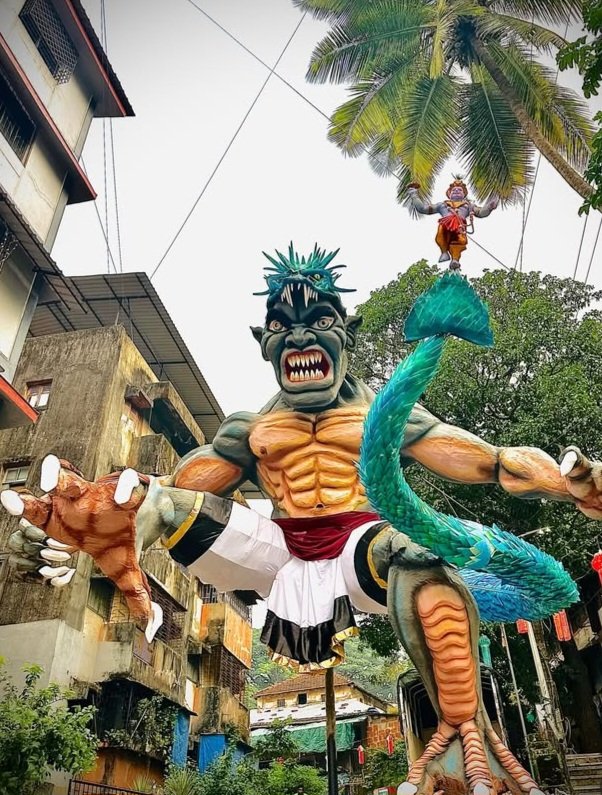
The story of Narkasur and his fame in Goa is one of those rare cultural tales that merges ancient mythology, colonial history, and modern-day celebration in a way that is uniquely Goan. For most of India, the name Narakasura is associated with the mythology of Diwali, particularly the day known as Naraka Chaturdashi, which marks the defeat of the demon king by Lord Krishna. In Goa, however, the legend takes on a far more vibrant and dramatic form, with grand effigies, noisy processions, and community-wide participation that begins well before dawn. The sight of massive, colorfully decorated yet fearsome effigies of Narkasur being paraded through the streets in the early hours of the morning is one of Goa’s most iconic festive traditions, and it is this annual spectacle that has made Narkasur famous across the state and beyond.
To understand why Narkasur holds such a prominent place in Goan culture, one must first turn to the mythology. Narakasura, according to Hindu texts, was a powerful asura (demon) who was the son of Bhudevi, the goddess of the earth. Blessed with great strength and a boon that made him nearly invincible, Narakasura became arrogant and tyrannical. He conquered kingdoms, terrorized people, and even kidnapped thousands of women, holding them captive in his palace. His reign of terror spread across the land until the cries of the oppressed reached the ears of the gods. It was then that Lord Krishna, accompanied by his wife Satyabhama, went to battle against Narakasura. In the fierce fight that followed, Krishna was struck unconscious for a moment, and Satyabhama, realizing her divine strength as an incarnation of Bhudevi herself, took up the bow and delivered the fatal blow. Narakasura was killed, and his death freed the captives and restored peace. His final wish, as he lay dying, was that his death be remembered with celebration, light, and joy — a wish that became the foundation for what is celebrated in Goa today.
In Goa, this legend is not just a story told in temples; it is a living tradition enacted every year on the night before Naraka Chaturdashi, which falls a day before the main Diwali celebrations. The event has grown into one of the most anticipated and colorful spectacles in the Goan festive calendar. Months before the date, groups of young men and boys in villages and towns begin preparing their Narkasur effigies. These are massive constructions, often towering over the streets at heights of 10 to 30 feet, made from bamboo, hay, cloth, and sometimes thermocol. The effigies are painted in bright, garish colors, with exaggerated demonic features — bulging eyes, long fangs, fierce expressions — designed to be as fearsome as possible. The effort that goes into creating these effigies is immense, and each group takes pride in making theirs the most impressive, the most terrifying, or the most creative.
On the night of the event, or sometimes in the very early hours before dawn, these effigies are brought out into the streets. Accompanied by drums, music, loud firecrackers, and enthusiastic cheering, they are paraded through neighborhoods. It is not uncommon to see dozens of these towering demons making their way through the narrow lanes, lit by streetlights and the occasional burst of fireworks. The atmosphere is electric, charged with both excitement and a sense of competition. Groups from different localities often try to outdo each other, and informal contests are held to judge the best effigy, the best presentation, or the most elaborate storytelling.
The culmination of the event comes with the burning of the effigies. As the crowds gather, the Narkasur figures are set alight, their massive forms quickly consumed by flames. The burning is symbolic of the victory of good over evil, of light over darkness, and of righteousness over tyranny. In the flickering firelight, people cheer and clap, and the sound of firecrackers fills the air. For children, it is a thrilling sight; for elders, it is a reaffirmation of cultural continuity.
One reason Narkasur is so famous in Goa is because the celebration here is far more public, elaborate, and visually spectacular than in most other parts of India. In many states, Naraka Chaturdashi is marked primarily with oil baths, early morning prayers, and lighting lamps. In Goa, it has become a street festival — a participatory, creative event that draws not only the makers of the effigies but also the entire community. The making and parading of Narkasur is a tradition passed down from one generation to the next, and many Goans have fond childhood memories of staying up late or waking before dawn to join the festivities.
The cultural roots of the celebration in Goa also have to do with the state’s history. During the Portuguese colonial era, many Hindu festivals were restricted, but local communities found ways to preserve them, often adapting them to fit within allowed public activities. The Narkasur tradition, with its combination of artistic craft, communal gathering, and symbolic meaning, was able to survive and even thrive. Over time, it became a point of local pride, with each village adding its own flavor to the celebrations. In coastal areas, for example, the effigies might include elements inspired by fishing life, while in the hinterland, agricultural motifs might appear.
The fame of Narkasur in Goa is also linked to the sheer scale of the celebrations in certain towns. Places like Panaji, Margao, Mapusa, and Ponda see large turnouts, with dozens of effigies competing for attention. The Panaji competition, in particular, draws crowds from across the state, and the winning effigy often becomes a talking point for weeks afterward. Local businesses sometimes sponsor groups, and the rivalry between neighborhoods can be intense. This competitive spirit has helped the festival grow in scale and creativity, ensuring that each year brings something new and memorable.
At the same time, the tradition has not been without controversy. In recent years, there have been debates over the excessive use of firecrackers, the environmental impact of burning synthetic materials, and the sometimes violent imagery used in the effigies. Some groups have responded by making eco-friendly Narkasurs from natural, biodegradable materials and by reducing noise pollution. Others have experimented with using the effigy as a platform for social messages, incorporating themes like environmental awareness, anti-corruption, or community harmony into the designs. These adaptations show how the tradition is evolving while retaining its core mythological symbolism.
The Narkasur celebration in Goa is also famous because it has become a tourist attraction. Visitors from other parts of India and abroad who happen to be in Goa during Diwali are often amazed at the sight of giant demons parading through the streets in the middle of the night. For them, it is a glimpse into a side of Goan culture that is far removed from the beaches and nightlife. Tourists often take photographs and videos, sharing them widely on social media, which in turn spreads the fame of the festival further.
Perhaps what makes Narkasur most famous, however, is the way it captures the Goan spirit — creative, communal, rooted in tradition but open to change, and unafraid to celebrate with color and energy. It is an event that engages the young and old alike, that calls on skills from carpentry to painting to event management, and that turns myth into a living, breathing part of everyday life. In those hours before dawn, when the drums beat, the fireworks crackle, and the effigies burn, one can feel the pulse of a community that takes pride in keeping its stories alive.
Over the years, the Narkasur tradition has also inspired other forms of art in Goa. Local tiatr (Konkani theatre) productions sometimes weave in the character of Narakasura as a metaphor for modern-day evils, while painters and sculptors have used the demon’s image in their work. The festival has become a subject of study for anthropologists interested in how ancient myths are localized and transformed in different cultural settings. In schools, children are taught the story of Narakasura not just as a religious tale but as part of their Goan heritage, linking them to a lineage of celebration that stretches back generations.
Even as modern life changes the rhythms of Goa, the Narkasur celebration remains firmly in place. In an era of digital entertainment, the hands-on, communal process of building an effigy from scratch, decorating it with care, and presenting it before the community has a special appeal. It is an act of creation followed by a symbolic act of destruction, a cycle that mirrors the Hindu understanding of time as eternal creation and dissolution.
When dawn finally breaks on Naraka Chaturdashi, and the last embers of the Narkasur effigies fade, the streets slowly quiet. People return home to continue the Diwali celebrations — lighting lamps, visiting temples, exchanging sweets. But the memory of the night’s spectacle lingers, a reminder of the triumph of light over darkness and of a tradition that belongs to Goa as much as its beaches and churches. That is why, year after year, Narakasura remains a name spoken with excitement in Goa — not because of his deeds in the myth, but because of the joy, artistry, and community spirit his story inspires.
In the weeks leading up to Naraka Chaturdashi, if you walk through the lanes of many Goan villages, you will see groups of young boys and men working late into the night under streetlights or in open courtyards. Bamboo poles lie stacked against walls, bundles of hay and old clothes are scattered around, and the smell of paint hangs in the air. The making of a Narkasur effigy is not just a last-minute activity; it is the result of days, sometimes weeks, of effort. The process begins with building the skeleton using bamboo — a frame that will give the demon its height and shape. This is followed by layering it with hay or other fillers to add volume, and finally dressing it in bright fabrics. The head is crafted separately, often with exaggerated horns, wide glaring eyes, and a mouth open in a terrifying roar. Once assembled, the whole figure is painted in vivid colors, with intricate details added to give it character.
In smaller villages, the making of Narkasur is a deeply social activity. Older men pass down tricks they learned decades ago — how to make the frame sturdy so it doesn’t topple during the parade, how to mix paints for a glowing effect under lights, or how to attach moving parts like waving arms or nodding heads. In some places, women contribute by stitching the costumes or helping decorate with beads, sequins, and other embellishments. Children act as eager assistants, carrying tools, fetching water, or simply watching in fascination. There is often laughter, playful teasing, and a fair bit of friendly competition between teams.
When asked why they put so much time and effort into building something that will be burned in a few hours, many participants give the same answer: “It’s our tradition.” For them, the creation and destruction of Narkasur is symbolic, but it is also a community event that strengthens bonds. A 62-year-old carpenter from a village near Mapusa once explained, “Every year I help the boys make the frame. My father taught me, and his father taught him. This is how our village has always celebrated. It’s not about the prize money or winning a competition; it’s about being part of something that belongs to us.”
In Goa’s capital city, Panaji, the Narkasur tradition has taken on a grander scale. The city hosts one of the largest Narkasur competitions in the state, with dozens of groups from different wards and surrounding areas participating. The competition here is fierce — effigies can reach over 30 feet in height and feature elaborate props, lighting effects, and sometimes even pyrotechnics. Some groups incorporate scenes from the myth, with smaller figures representing Lord Krishna, Satyabhama, or the captives being freed. Others take a more creative route, blending the traditional demonic features of Narkasur with modern political or social commentary.
The Margao competition in South Goa is equally famous. Here too, the emphasis is on size and creativity, but the community atmosphere is different. The parade winds through the heart of the town, drawing crowds who cheer and applaud each passing effigy. The judges look for craftsmanship, adherence to the mythological theme, and overall presentation. The winning group often gains prestige that lasts until the next year’s competition, and for some teams, the victory is a matter of local pride.
In smaller towns and villages, the celebrations may not have the same scale, but they often have a stronger sense of intimacy. In a village in Quepem, for example, the Narkasur is paraded on a bullock cart, accompanied by traditional dhol-tashe drums and folk songs. In another village in Sattari, the effigy is taken from house to house, where residents offer snacks and drinks to the participants. These variations reflect the diversity within Goa — coastal areas, inland farming communities, and urban centers all bring their own flavor to the tradition.
For the artisans who build the largest effigies, Narkasur season is also an opportunity to showcase their skills. Some of these makers are involved in stage set design for tiatr plays or in float construction for carnival parades during other times of the year. They see Narkasur not just as a demon from myth but as a canvas for artistic expression. A well-known effigy maker from Ponda once said, “Every year, I try to make something people will remember. Yes, Narkasur is the villain, but in art, even a villain can be beautiful in his own way.”
The role of local youth groups, often called “mandals,” is central to keeping the tradition alive. These mandals organize fundraisers, collect materials, assign tasks, and ensure that the effigy is completed on time. They also handle the logistics of moving the massive structures through narrow streets — a task that requires careful coordination. In some areas, two or three villages might join forces to create an especially large Narkasur, sharing costs and labor.
In recent years, environmental concerns have prompted changes in how the effigies are made and burned. Traditionally, the figures were made of biodegradable materials like bamboo, hay, and cloth. However, modern additions like thermocol, synthetic fabrics, and chemical paints caused pollution when burned. Responding to criticism, many groups are now returning to eco-friendly materials and natural paints. Some mandals have even won awards for creating entirely biodegradable Narkasurs.
Another evolving aspect is the use of the effigy as a medium for social messages. While the demon remains the central figure, some designs incorporate symbolic elements — a chain around his waist representing corruption, shackles symbolizing oppression, or even environmental motifs like burning forests or polluted rivers. This blend of tradition with contemporary issues adds a layer of relevance to the celebration, allowing it to speak to present-day challenges while honoring its mythological roots.
For visitors, the Narkasur night is a sensory overload. The air is filled with the smell of burning hay and gunpowder from firecrackers. The beat of drums echoes down the streets, accompanied by the occasional burst of music from loudspeakers. People of all ages crowd the sidewalks, craning their necks to see the towering demons pass by. Children clap their hands in delight, teenagers take selfies with the effigies, and elders exchange knowing smiles, remembering how they too once marched in these processions.
The burning of the effigy is the climactic moment. As the flames consume the demon, there is a collective cheer, and the symbolism is clear — the victory of good over evil. It is a moment of release, of catharsis, marking the end of months of preparation in a blaze of light and heat. In that instant, the entire community is united in a shared emotional high.
Once the fires die down, the celebrations transition into the quieter rituals of Naraka Chaturdashi. People return home, take oil baths, and prepare for the rest of the Diwali festivities. Lamps are lit, sweets are exchanged, and the focus shifts from the destruction of evil to the welcoming of prosperity and light. Yet, the memory of the Narkasur procession remains fresh, and conversations often drift to which effigy was the biggest, the most creative, or the most fearsome.
It is this blend of myth, artistry, competition, and community participation that makes Narkasur so famous in Goa. It is not just about remembering a demon from ancient stories; it is about turning that story into a living, breathing event that involves almost everyone. From the young boys tying bamboo poles to the elders recounting the legend, from the artisans painting fearsome eyes to the judges deciding the winners, the Narkasur tradition is a collective creation.
In a rapidly changing world, where many old customs fade away, the continued enthusiasm for Narkasur in Goa is remarkable. It shows that traditions can survive and thrive when they adapt to the times while holding onto their essence. Whether through eco-friendly materials, modern social themes, or just the timeless joy of making something grand and burning it in symbolic victory, Narkasur remains a celebration that belongs to the people.
When the next year’s season rolls around, the cycle begins anew — bamboo is cut, paint is mixed, ideas are exchanged, and once again, the demon will rise, only to be brought down in flames. And with every year, his fame grows, not as a terror of myth, but as a beloved villain of Goan culture, whose defeat is a cause for unity, creativity, and joy.